
$40 Trillion US Debt Spiral Threatens Global Markets, CEO Warns


Key Takeaways
- U.S. debt remained above $40 trillion in the latest Treasury data.
- CBO raised its fiscal 2026 deficit estimate to $2.1 trillion, $200 billion above its February projection.
- Green warns that rising yields could spread financial pressure globally.
US Debt Creates a Costly Feedback Loop
Rising federal interest costs could intensify financial-market pressure without an economic downturn or new emergency, Devere Group CEO Nigel Green warned on Aug. 24. He argued that borrowing required to finance existing interest expenses creates larger future obligations as older, lower-cost debt matures and is refinanced at higher rates.
Green explained:
“This is arithmetic, not sentiment. Interest is compounding faster than the economy generating the revenue to pay it, so every dollar borrowed to cover last year’s interest bill creates a larger interest bill this year, regardless of who sits in the White House or what the Federal Reserve decides next.”
Official Treasury figures show that total public debt outstanding stood at approximately $40.03 trillion on Aug. 20. About $32.28 trillion was held by the public, including investors and institutions, while approximately $7.75 trillion represented intragovernmental holdings involving federal accounts and trust funds.
CBO Raises Its 2026 Deficit Estimate
The federal outlook has worsened since the Congressional Budget Office (CBO) published its February baseline. The agency now estimates a $2.1 trillion deficit for fiscal 2026, $200 billion above the $1.9 trillion projected on Feb. 11, after cutting its revenue estimate on weaker tariff collections.
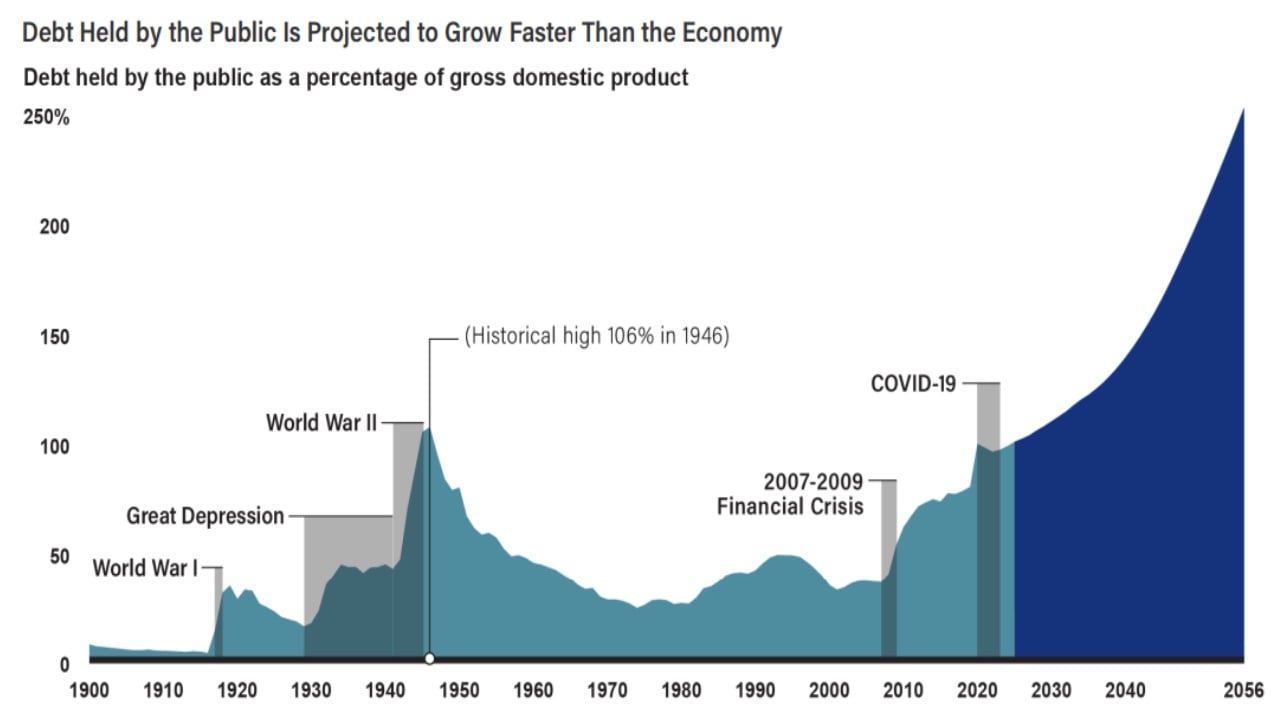
CBO said on Aug. 20 that trade policy changes through July 31 add another $0.9 trillion to projected deficits across 2027 through 2036. Its February baseline had debt held by the public rising from 101% of gross domestic product this year to 120% by 2036, with the annual deficit reaching $3.1 trillion — figures the agency has not yet restated.
In a June 11 report, the U.S. Government Accountability Office (GAO) projected that debt held by the public will reach 123% of GDP in 2036 and 251% by 2056 under current revenue and spending policies.
Higher benchmark yields also reach households through mortgages and other forms of long-term credit. The average 30-year fixed mortgage rate was 6.65% as of Aug. 20, according to Freddie Mac, compared with the record low of 2.65% in January 2021. Mortgage rates do not follow Treasury yields point for point, but both respond to inflation expectations, monetary policy, and investor demand for long-term debt.
Foreign Investors Share the Treasury Market Risk
International investors remain exposed to changes in U.S. yields through their extensive holdings of Treasury securities and other dollar assets. Treasury International Capital data released Aug. 17 showed that foreign residents made $207.1 billion in net purchases of long-term U.S. securities during June. Treasury cautions that custodial arrangements prevent the data from identifying each country’s ultimate ownership with complete accuracy.
Recent Treasury intervention illustrates the pressure facing longer-dated government securities as borrowing requirements expand. The department increased certain buyback operations for 10- to 30-year debt from $2 billion to at least $4 billion per operation, effective Sept. 9 through Nov. 4. The purchases can support liquidity and reduce near-term yield pressure, but they do not cancel debt or constitute Federal Reserve quantitative easing.
Higher Yields Pressure Stocks and Bonds
That debt feedback loop extends beyond government financing as Treasury yields establish a baseline for mortgages, business loans, and corporate bonds. The $40 trillion debt milestone has intensified concerns that higher refinancing costs can expand interest expenses, widen deficits, and require further Treasury issuance. New government borrowing must also compete with corporate debt for investor capital.
Elevated discount rates can reduce the present value investors assign to companies whose expected earnings lie further in the future. Recent movements across bitcoin, stocks, gold, and bonds showed how changes in long-term yields can affect multiple asset classes simultaneously. Green warned:
“Portfolios built for low, stable yields are now carrying risk most investors have not repriced.”
Bitcoin Enters the Debt Debate
Some investors are responding to fiscal and currency concerns by considering scarce assets alongside traditional portfolio holdings. Bridgewater Associates founder Ray Dalio warned that U.S. debt could reach between $55 trillion and $60 trillion within a decade. He favors gold and a smaller bitcoin allocation while recommending reduced exposure to debt assets, although his projection represents an assessment rather than an official government forecast.
Bitcoin’s programmed scarcity supports its long-term currency-debasement argument, but its short-term performance remains highly volatile. BTC’s fixed supply of 21 million coins distinguishes it from government-issued currencies. However, its record during inflation shocks remains mixed, making the asset more defensible as a long-term scarcity hedge than a reliable short-term safe haven.


Comments are closed.